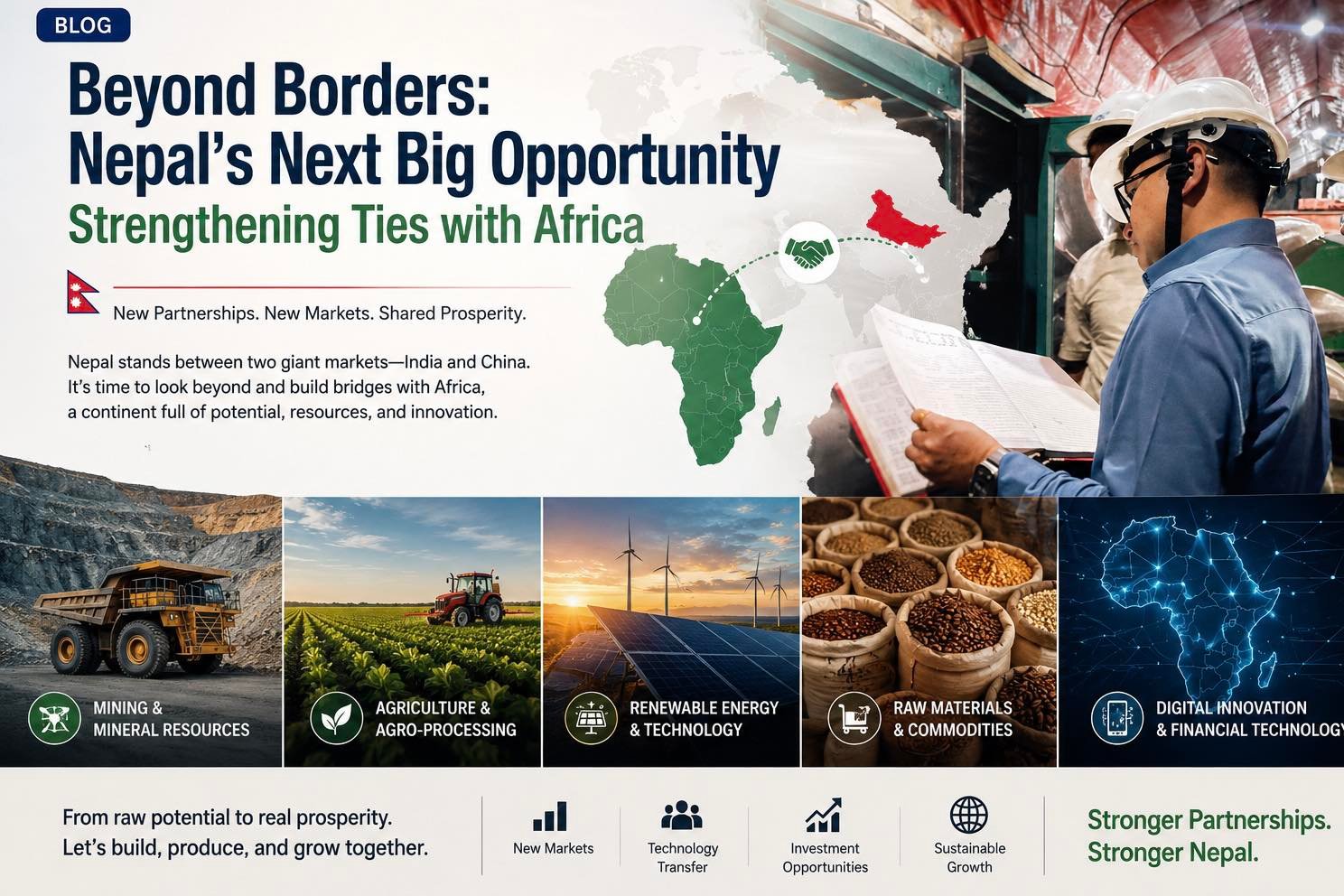
Africa-Nepal economic partnership offers immense opportunities beyond traditional trade and diplomacy. Africa is often viewed only as a source of raw materials, but many African nations have become leaders in innovation, technology adoption, agriculture, renewable energy, mining, and digital transformation. Nepal can benefit significantly by building stronger trade and investment partnerships with these countries.
1. South Africa – Mining, Manufacturing & Financial Services
South Africa has one of Africa’s most advanced industrial economies. Nepal can learn from its mining technology, mineral processing, industrial manufacturing, and financial services sectors. As Nepal explores minerals such as copper, limestone, and rare earth elements, South African expertise could help develop these industries sustainably. In addition, collaboration with South African companies could attract investment and create new employment opportunities in Nepal. Such cooperation would further strengthen the Africa-Nepal Economic Partnership and support Nepal’s long-term industrial growth.
2. Kenya – Digital Payments & Agri-Tech
Kenya revolutionized mobile banking through M-Pesa and became a global example of financial inclusion. Under the Africa-Nepal Economic Partnership, Nepal can adopt similar digital payment innovations to help rural populations access banking services. Kenya also has strong expertise in agricultural technology, irrigation, and agricultural exports.
3. Rwanda – Digital Governance & Startup Ecosystem
Despite being a small landlocked country, Rwanda transformed itself into one of Africa’s most business-friendly economies. Nepal can learn from Rwanda’s e-governance systems, digital public services, startup incubation programs, and investment promotion strategies. Rwanda’s success demonstrates how effective governance and innovation can drive rapid economic development even in landlocked countries.
4. Ethiopia – Industrial Parks & Export Manufacturing
Ethiopia successfully attracted foreign investors into the textile, leather, and manufacturing sectors through industrial parks. Nepal can replicate similar export-oriented manufacturing zones to produce goods for India, China, and global markets. The Africa-Nepal Economic Partnership could play a key role in enabling this approach and boosting Nepal’s industrial output while creating large-scale employment opportunities for its growing workforce.
5. Ghana – Agro-Processing & Food Exports
Ghana has built a strong agro-processing sector around cocoa, fruits, and agricultural products. Nepal can collaborate on food processing technologies, packaging, and export standards for products such as tea, coffee, spices, herbs, and honey. Such collaboration could help Nepal strengthen its agricultural value chain and increase competitiveness in international markets.
6. Botswana – Natural Resource Management
Botswana transformed diamond wealth into national prosperity through transparent governance and strategic planning. Nepal can learn valuable lessons in resource management, public-private partnerships, and investment governance. The Africa-Nepal Economic Partnership offers a framework for adopting such best practices while promoting long-term economic stability.
7. Morocco – Renewable Energy & Fertilizer Industry
Morocco is a global leader in solar energy and fertilizer production. Nepal can partner with Moroccan companies for renewable energy projects and agricultural productivity improvements. This cooperation could accelerate Nepal’s transition toward sustainable energy while enhancing agricultural efficiency and output.
Business Opportunities for Nepal
Rather than simply importing products, Nepal can position itself as a production and value-addition hub between India and China. African countries can provide technology, industrial expertise, investment, and raw materials. At the same time, Nepal offers a strategic location, affordable labor, hydropower potential, and access to two of the world’s largest consumer markets.
For example, raw cotton from Africa could be processed into garments in Nepal and exported to India and China. African coffee beans could be blended and packaged in Nepal for regional markets. Similarly, technology partnerships in digital finance, agriculture, and renewable energy could create new industries and jobs within Nepal. The Africa-Nepal Economic Partnership can catalyze turning these opportunities into reality.
The future of Nepal’s diplomacy should focus not only on political relations but also on economic partnerships that bring technology, investment, market access, and industrial growth. Africa presents a largely untapped opportunity that could help Nepal diversify its economy and strengthen its position in global trade.