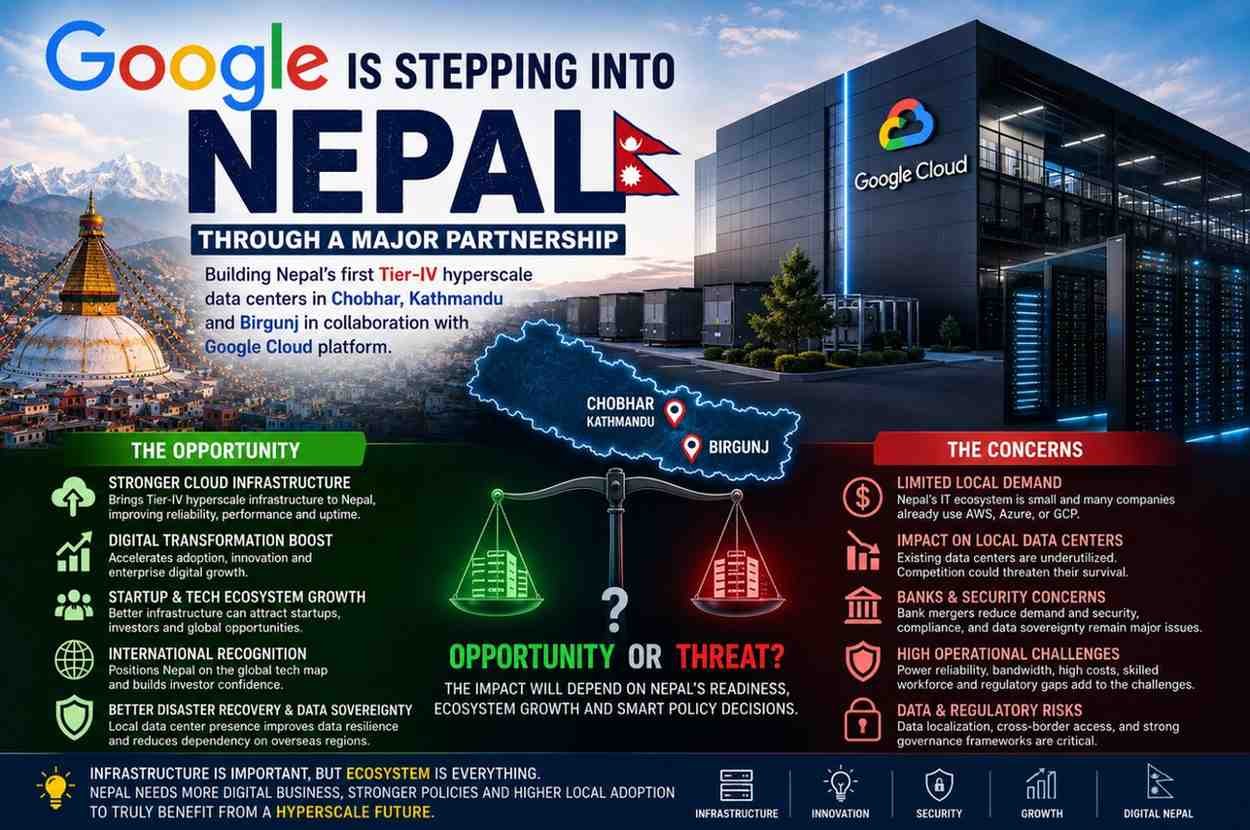
The recent reports about Google partnering to develop Nepal’s first Tier-IV hyperscale data centers in Chobhar and Birgunj have created excitement across Nepal’s technology sector. Many are calling it a historic step toward digital transformation, cloud infrastructure growth, startup innovation, and global technology recognition for Nepal.
On the surface, this sounds like a breakthrough moment for the country. A global technology giant entering Nepal could improve international confidence, attract foreign investment, and encourage modernization of digital infrastructure.
However, beneath the excitement lies a more complicated reality.
The question Nepal must ask is not only “Can Google build a hyperscale data center in Nepal?” but also “Does Nepal currently have enough demand to sustain such an investment?”
Nepal’s Existing Data Center Market Reality
Nepal is not entering an empty market. The country already has several established local data centers operating with significant infrastructure investments. Over the past decade, Nepali companies have invested heavily in:
- Physical infrastructure
- Cooling systems
- Power redundancy
- Security compliance
- Disaster recovery systems
- Network infrastructure
- Cloud hosting services
Despite these investments, many local data centers are still struggling with occupancy and business growth.
A major challenge is that Nepal’s enterprise digital ecosystem remains relatively small. The number of large-scale technology companies, enterprise SaaS businesses, fintech firms, and cloud-native organizations in Nepal is still limited compared to regional markets.
Most Nepali businesses do not operate at hyperscale levels.
Nepal’s IT Industry is Already Cloud-Based
One of the biggest realities often ignored in discussions is that many Nepali IT companies are already heavily dependent on international cloud platforms such as:
- Amazon Web Services (AWS)
- Microsoft Azure
- Google Cloud
- DigitalOcean
- Alibaba Cloud
Most software companies in Nepal build products for international clients. Their hosting environments are usually selected based on:
- Global latency
- International customer reach
- Pricing
- Scalability
- Existing ecosystem integration
This means that even if a hyperscale data center is built physically inside Nepal, it does not automatically guarantee migration of workloads into Nepal.
Many applications serving Australia, Europe, or the US will still prefer Singapore, Mumbai, Sydney, Frankfurt, or US-based regions for performance and compliance reasons.
The Economics of Data Centers in Nepal
Operating a large-scale data center is extremely expensive.
The costs include:
- Electricity consumption
- Cooling systems
- Generator backup
- Fuel
- Physical security
- Internet backbone connectivity
- Skilled engineers
- Maintenance
- Hardware lifecycle replacement
- Compliance and certification
Nepal already faces challenges related to:
- Power reliability perceptions
- International bandwidth dependency
- Limited enterprise demand
- High operational costs
- Limited local cloud adoption
If local data centers themselves are not yet fully occupied, introducing a hyperscale global competitor may intensify market pressure rather than strengthen the ecosystem immediately.
Direct Impact on Local Data Centers
This development could place existing Nepali data center operators in a difficult position.
Local companies that invested millions into infrastructure based on expected future growth may now face:
- Reduced pricing power
- Customer migration risks
- Difficulty recovering investments
- Increased competition from global-scale pricing models
- Pressure to modernize faster
- Reduced market share
Many local operators are still trying to stabilize their businesses and achieve sustainable occupancy rates. Some facilities reportedly remain significantly underutilized even today.
A hyperscale entry by Google could potentially disrupt the local market before it matures enough to compete.
Banking Sector Limitations
Nepal’s banking sector is often viewed as the primary customer base for local data centers. However, this market also has limitations.
Recent mergers between banks have reduced the total number of banking institutions in the country. Fewer banks mean:
- Fewer infrastructure contracts
- Consolidated IT operations
- Reduced hosting demand
- Centralized systems
Additionally, banks in Nepal remain cautious regarding:
- Data sovereignty
- Regulatory compliance
- Cybersecurity risks
- Vendor dependency
- International cloud governance
Many financial institutions still prefer hybrid or highly controlled infrastructure environments rather than fully outsourcing sensitive systems to external hyperscale providers.
Security and Regulatory Concerns
Data localization and national security concerns will also become major discussion points.
Questions Nepal must consider include:
- Where will sensitive national data be stored?
- Who controls the infrastructure?
- What laws govern cross-border data access?
- How will government agencies regulate hyperscale operations?
- Can Nepal enforce data protection standards effectively?
Without strong cybersecurity regulations and data governance frameworks, rapid hyperscale expansion could create policy and sovereignty challenges.
The Positive Side: Long-Term Potential
Despite these concerns, the project should not be viewed entirely negatively.
A Google-backed hyperscale initiative could still provide long-term benefits:
- Improved international internet infrastructure
- Better cloud adoption awareness
- More digital skill development
- Attraction of foreign technology investments
- Increased startup confidence
- Better disaster recovery standards
- Growth of Nepal’s digital economy
It may also encourage local data centers to:
- Upgrade services
- Improve compliance standards
- Offer competitive pricing
- Focus on niche enterprise solutions
- Build stronger managed service offerings
Competition can drive innovation — but only if the local ecosystem is prepared.
Nepal Needs Ecosystem Growth First
The core issue is not whether Google should invest in Nepal.
The real issue is whether Nepal’s current digital economy is large enough to justify hyperscale infrastructure at this stage.
For Nepal to truly benefit from such investments, the country first needs:
- More enterprise technology adoption
- More SaaS companies
- More startups scaling globally
- Better digital policies
- Stronger cybersecurity frameworks
- Increased local cloud demand
- More digital transformation across industries
Without expanding the overall market, hyperscale infrastructure alone may not create the expected economic impact.
I Believe
Google’s possible entry into Nepal’s data center sector is undoubtedly a landmark moment. It signals that Nepal is beginning to appear on the global technology map.
However, excitement should be balanced with practical market realities.
Nepal’s local data center industry is still developing. Many operators are already struggling with underutilization, high operational costs, and limited enterprise demand. The arrival of a global hyperscale player could either accelerate modernization or destabilize local investments depending on how the ecosystem evolves.
The future success of such a project will depend not just on infrastructure, but on whether Nepal can grow its broader digital economy to support it.
A hyperscale data center alone cannot transform Nepal’s technology sector.
The real transformation will come when Nepal creates enough digital business demand to make such infrastructure truly necessary.